

Risk Mapping of Environmental Factors for Echinococcus multilocularis Infections in Red Foxes (Vulpes vulpes) on Rügen Island
bearbeitet am Institut für Epidemiologie
As part of an interdisciplinary One Health research collaboration at the Friedrich-Loeffler-Institut (FLI), my master’s thesis focused on environmental risk factors associated with Echinococcus multilocularis infections in red foxes on Rügen Island. E. multilocularis, also known as the “fox tapeworm,” can cause alveolar echinococcosis – a rare but potentially life-threatening disease in humans. While the parasite has long been associated with southern Germany, its spread toward northern regions highlights the growing importance of surveillance and environmental risk assessment.
The project combined wildlife surveillance, parasitology, spatial epidemiology, and environmental analysis through the collaboration of researchers, laboratory teams, and local hunting communities. Using geographic data from hunted foxes collected across Rügen Island together with detailed environmental land-cover information, our work focused on developing the first spatial environmental risk map for E. multilocularis on the island. By analysing landscape structures surrounding fox habitats, the study identified environmental and seasonal patterns potentially associated with increased infection risk, particularly in agricultural areas.
The generated risk map contributes to the “One Health” approach, which recognizes the close connections between wildlife, domestic animals, the environment, and human health. These findings may support future surveillance strategies, targeted prevention measures, and public-health awareness efforts on Rügen Island, an important tourist destination with increasing human–wildlife interaction.
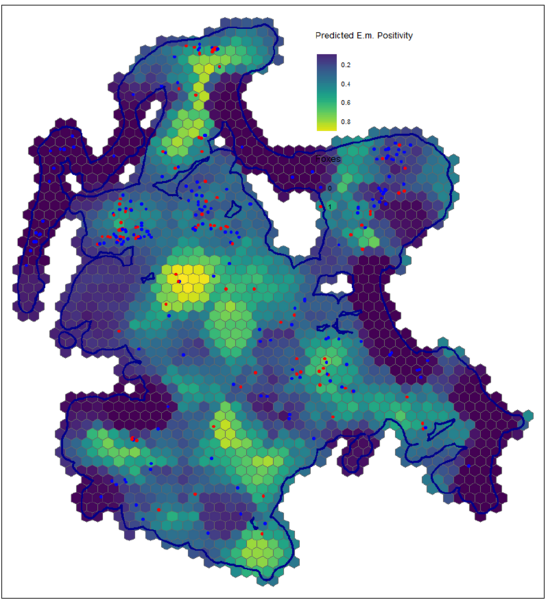
Fig. 1: Predicted probability of Echinococcus multilocularis positivity in red foxes across Rügen Island using spatial epidemiological modelling. The map shows the model-predicted distribution of fox infections overlaid with actual fox sample locations (red = positive, blue = negative). Areas with higher predicted values may represent potential hotspots.
This work was carried out under the supervision of Dr. Dr. med. vet. Hannes Bergmann, whose scientific expertise and vision were central to its development. The study formed part of a larger collaborative research effort involving Josefine Wassermann, Alrik-Markis Kunisch, Martina Abs, Jonas Heck, Pavlo Maksimov, Annette Johne, Kerstin Wernike, Carola Sauter-Louis, Christoph Staubach, Gereon Schares, and the wider FLI and WiMoPOH research teams, as well as the local hunting community on Rügen Island.
I am sincerely grateful to the members of the Förderverein des Friedrich-Loeffler-Instituts for their generous support and for recognizing our collaborative work.